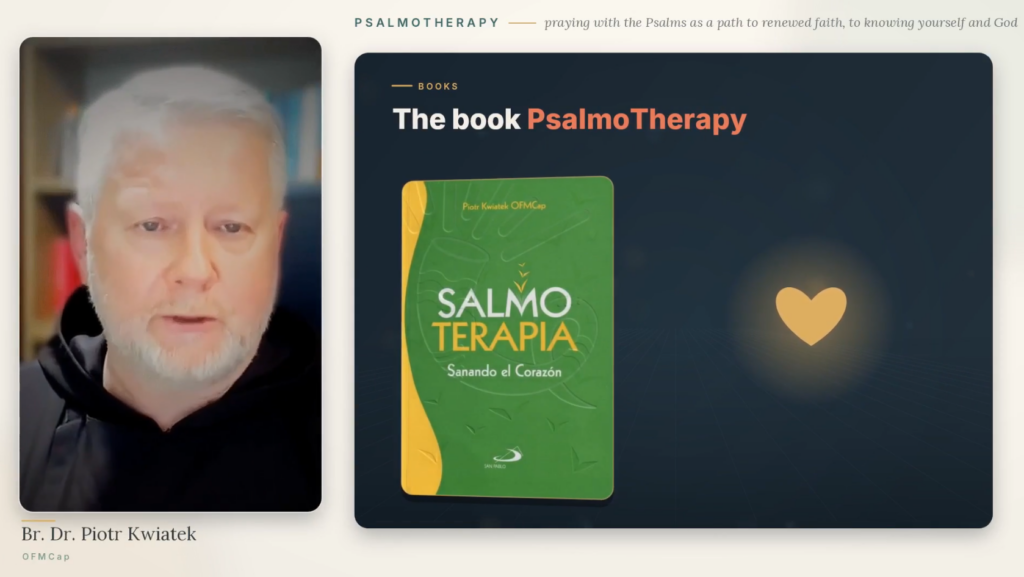
Dziś na YouTube udostępniłem konferencję o psalmach w języku angielskim (w dwóch częściach, po około 20 minut każda), którą przygotowałem dla Sióstr Nazaretanek – także tych, które mówią wyłącznie po angielsku. Ufam, że zastosowana technologia tłumaczenia pomoże przybliżyć psalmoterapię osobom nierozumiejącym języka polskiego.
Książka Psalmoterapia została już przetłumaczona na język hiszpański „Salmoterapia Sanando el Corazón https://www.librerianacional.com/salmoterapia-sanando-el-corazon/p) – może nadszedł czas, aby ona lub inne moje książki ukazały się także po angielsku? Kto wie! Jeśli macie znajomych, którzy chcieliby posłuchać o psalmoterapii po angielsku, nagranie jest już dostępne.
Today, I shared on YouTube a conference on the Psalms in English (in two parts, about 20 minutes each), which I prepared for the Sisters of the Holy Family of Nazareth – including those who speak only English. I trust that the translation technology used will help bring PsalmoTherapy closer to people who do not understand Polish.
The book Psalmoterapia has already been translated into Spanish („Salmoterapia: Sanando el Corazón” – https://www.librerianacional.com/salmoterapia-sanando-el-corazon/p) – maybe it is time for it or some of my other books to be published in English as well? Who knows! If you have friends who would like to listen about PsalmoTherapy in English, the recording is already available.
- This conference, titled „PsalmoTherapy: Praying with the Psalms as a path to renewed faith, to knowing yourself and God” and delivered by fr. Piotr Kwiatek OFMCap was recorded in Polish for the Sisters of the Holy Family of Nazareth and translated into English using AI technological tools for those who communicate in this language.
Father Piotr Kwiatek OFMCap is a doctor of psychology, a priest and a friar of the Kraków Province of the Order of Friars Minor Capuchin. He completed a three-year Gestalt therapy program in Philadelphia (USA) and training in Rational Emotive Behavior Therapy (REBT) at the Albert Ellis Institute in New York. He initiated psalm therapy, a way of praying the Psalms supported by psychological insight. It helps people name and accept their emotions, come to know themselves in God’s presence and build inner peace. He leads workshops, lectures and retreats, combining mature psychology with a living spirituality. He also writes commentaries on the liturgical psalms for the Heschel Center at the Catholic University of Lublin (KUL). He is the author of popular books in the Positive Psychology and Faith series: Love God and Don’t Be Afraid to Be Happy, Rejoicing in Life: Four Windows of Gratitude, In the Light of the Shadow: Difficulties on the Road to Happiness, The Art of Living Without Complaining, Giving Wings to Spirituality, Dobroteka: Seeds of Positivity and Psalmoteka: Biblical Inspirations for a Good Life. He has also written books in the Psalm Therapy in Practice series, including Psalm Therapy, Mirror of the Soul and Mirror of Adversity. He created Dobroteka 2.0, a free mobile app that helps people build well-being and practice gratitude. The Psalms: Four Dimensions of Prayer
Conference concept
The Psalter is a school of prayer that engages the whole person. This conference introduces the biblical world of the Psalms and their place in Sacred Scripture. It also presents four dimensions of praying them that the Church is still called to rediscover.
1. Existential: the psalm as a mirror of life. Beyond exegesis, the Psalms speak to my life. I do not so much question the Psalms as let them question me. In the psalmist’s words I recognize my own story, fears and hopes, and bring them honestly before God.
2. Therapeutic: the psalm as a path to healing. The Psalms show the whole person, with successes and failures, struggles and mistakes, who still keeps praying. They teach us to name our emotions rather than suppress them. Above all, they lead us into a relationship with the One who heals, bringing inner order, resilience, gratitude and trust.
3. Paschal: the psalm as the prayer of Christ. Jesus prayed the Psalms, even on the cross. Like the early Church, we learn to pray them in the light of the New Testament and to see Christ in them. Read this way, they lead through suffering toward the resurrection.
4. Contemplative: the psalm as a doorway to silence. What matters is not the number of prayers but the quality of our presence before God. Slow reading and repeating a single verse open a space for simply abiding in Him.
Aim: to show that the Psalms unite life, healing, faith and contemplation, and to offer simple tools for praying them every day.